Kilimanjaro Flora & Fauna: Plants, Wildlife & Zones | Exuberant Kilimanjaro Safaris
Cultivated foothills
The lowest slopes around the park boundary are farmed Chagga land — smallholdings of banana, coffee and vegetables, with patches of remnant forest along watercourses. Most routes begin above this zone, at the park gate.
Montane forest
A dense, damp cloud-forest belt wraps the lower mountain. Tall trees, tree ferns, mosses and hanging lichens thrive in the cloud trap. This is the richest zone for wildlife: black-and-white colobus and blue monkeys are possible here, along with bushbuck, duiker and forest birds. Sightings are never guaranteed.
Heath & moorland
Above the treeline the forest opens into heather and moorland. Giant groundsels (Dendrosenecio) and giant lobelias — plants found only on East African mountains — rise above the heather. Temperatures drop and nights grow cold.
Alpine desert
Higher still, the landscape becomes sparse and stark. Lichens cling to rocks and a few hardy plants persist, but vegetation is scarce. The broad Kibo–Mawenzi Saddle is a high-altitude desert plain with wide views toward the crater rim.
Summit (arctic) zone
Near the summit, conditions are arctic: freezing nights, ice, scree and very little life. Glaciers and the Furtwängler Glacier cling to the summit cone. Vegetation is essentially absent at this altitude.
Forest primates
Black-and-white colobus and blue monkeys are the primates most associated with Kilimanjaro, living in the montane forest. They are possible to see but never guaranteed — keep voices low on the lower trails.
Forest mammals
Bushbuck and duikers may be glimpsed along forest glades in the lower forest belt. These smaller antelopes are the mammals trekkers are most likely to notice on the lower trails.
Elusive larger mammals
Buffalo, elephant and leopard occur within the park but are shy, mostly avoid the busy trails and are rarely seen by trekkers. They live away from the standard climbing routes, so treat any sighting as exceptional rather than expected.
Birdlife
Kilimanjaro is noted for montane-forest birds and high-elevation specialists. Sunbirds, forest birds and raptors may be seen over ridges and moorlands. Birdlife thins out rapidly above the moorland zone.
Discover Mount Kilimanjaro’s plants, wildlife and five ecological zones, from rainforest monkeys and colourful flowers to giant groundsels.
Exuberant Kilimanjaro Safaris
Kilimanjaro Flora & Fauna: Plants, Wildlife & Zones | Exuberant Kilimanjaro Safaris
Life on the Mountain
Kilimanjaro Flora & Fauna
Kilimanjaro's dramatic elevation gradient — from warm farmland at the gate to freezing ice at 5,895 m — creates five classic ecological zones. The boundaries between them are gradual and vary with slope, aspect and local conditions, so the descriptions below are a general guide rather than fixed lines on a map. Wildlife sightings are always possible, never guaranteed.
The five ecological zones
Each zone is shaped by altitude, temperature and moisture. You will notice the change most clearly as the forest gives way to open moorland, and again as the moorland gives way to the stark alpine desert.
Plants & wildlife you may encounter
Most of Kilimanjaro's wildlife lives in the montane forest, the first zone above the gate. Higher up, life becomes sparse — the giant groundsels and lobelias of the moorland are the mountain's most distinctive plants. Treat every sighting as a bonus, and never approach or feed wildlife.
A closer look
From Kilimanjaro rainforest plants to alpine flowers, these examples illustrate the variety of vegetation on the mountain. Zones overlap, and individual plants are not confined to rigid boundaries. The photographs are from Exuberant Kilimanjaro Safaris’ February 2021 posts.
Montane forest plants
In the moist forest, look closely at the branches and understory: some of the mountain’s most striking life is easily missed.
Kilimanjaro impatiens / elephant’s trunk flower
Impatiens kilimanjari · Typical habitat: moist montane forest
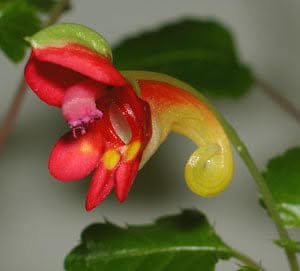
One of Kilimanjaro’s distinctive forest flowers, this impatiens is recognised by its vivid red, yellow and pink colouring and curved floral spur, which has earned it the nickname “elephant’s trunk flower”. It is associated with moist montane rainforest, particularly forest trails on the southern slopes, and is a beautiful example of the biodiversity encountered before the more exposed upper zones.
Old man’s beard lichen
Usnea species · Typical habitat: moist mountain forest
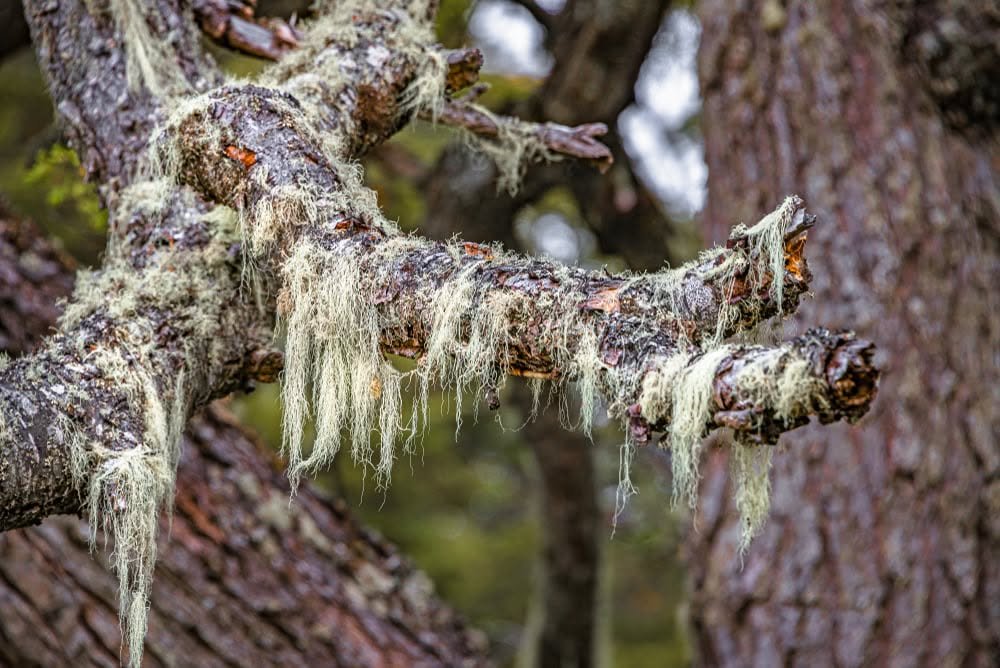
Pale grey-green Usnea often hangs from branches like delicate strands of hair. Although it can resemble moss or a small plant, lichen is a partnership involving fungi and photosynthetic organisms. It is particularly noticeable in moist mountain forests, where it contributes to their distinctive appearance.
African Blood Lily (Fireball Lily)
Scadoxus multiflorus · Formerly Haemanthus multiflorus · Typical habitat: tropical and montane forest margins
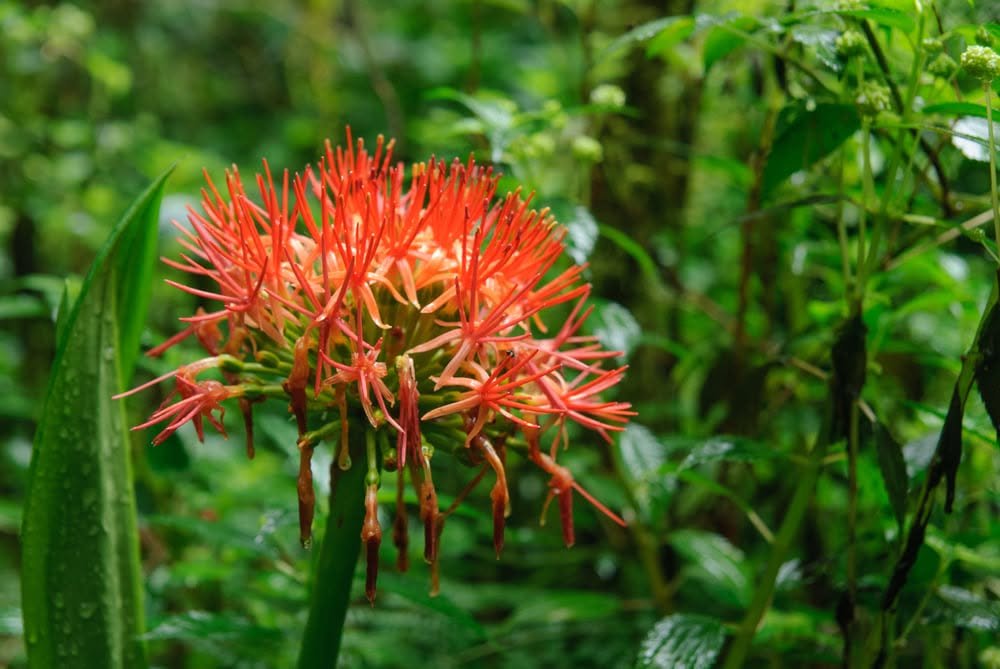
With its brilliant red-orange globe of slender flowers, the African blood lily is one of East Africa's most striking flowering plants. Its rounded flowerhead is made up of numerous small flowers, creating a spectacular firework-like display. Native to Tanzania, this bulbous plant belongs to the Amaryllis family. Its bulbs and other parts are poisonous if ingested, so admire it without collecting or handling it.
Heath and moorland plants
As forest gives way to open heath, shrubs, grasses and remarkable flowering plants are shaped by wind, bright sun and cold nights.
Hebenstretia
Hebenstretia dentata · Typical habitat: heath and moorland
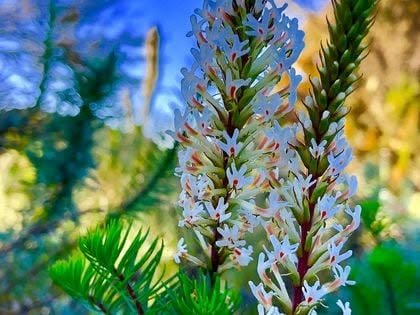
This flowering perennial produces upright spikes of small, predominantly white flowers. Its slender stems rise among grasses and shrubs on the open heath, where it flowers during the warmer months and reaches roughly 60 cm in height.
Red-hot poker
Kniphofia thomsonii · Typical habitat: heath and moorland
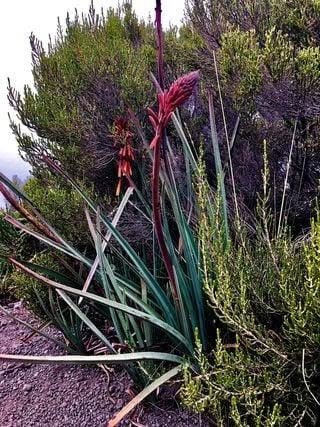
The striking red-hot poker brings colour to heath and moorland. Its upright spikes carry vivid red and orange tubular flowers above the surrounding grasses and shrubs. It belongs to the genus Kniphofia, whose distinctive flower spikes are also familiar in ornamental gardens.
Kilimanjaro protea / sugarbush
Protea afra subsp. kilimandscharica · Also familiar as Protea kilimandscharica · Typical habitat: heath and moorland
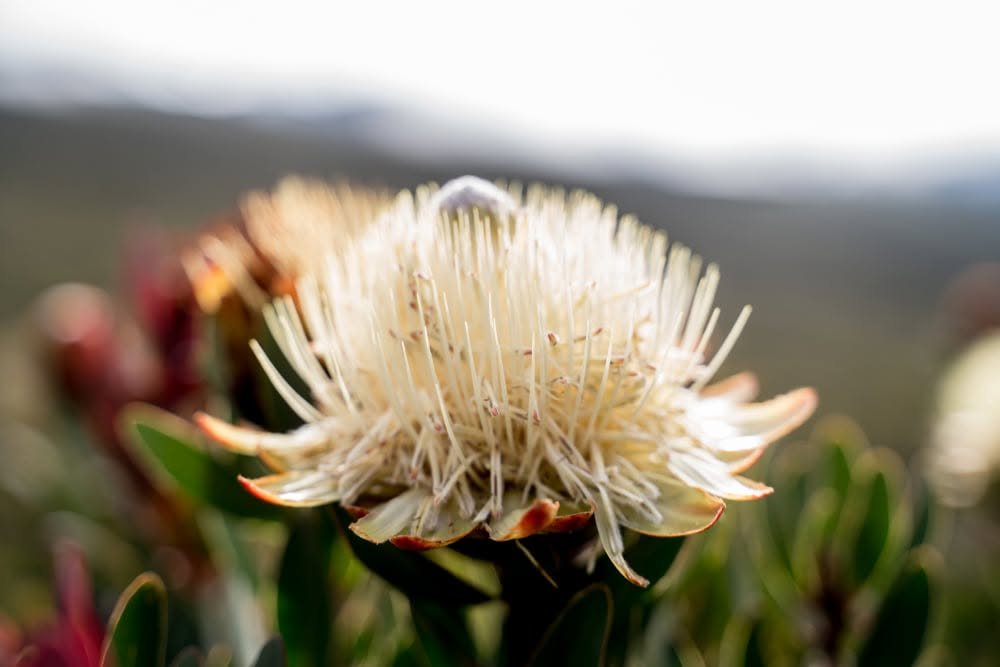
This distinctive flowering shrub has remarkable flowerheads made up of numerous small flowers surrounded by protective bracts. Proteas belong to an ancient lineage of flowering plants. Their genus takes its name from Proteus, the shape-changing figure of Greek mythology.
Tussock grass
Typical habitat: open heath and moorland
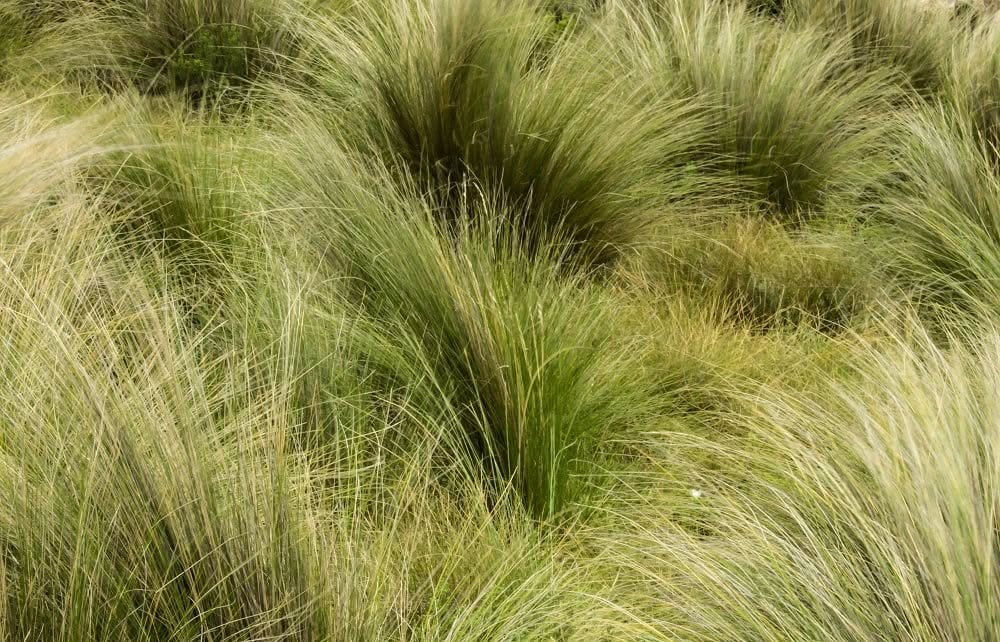
Tussock grasses form dense bunches rather than continuous lawns. Narrow leaves and extensive roots help them cope with exposed conditions and periodic water shortages, while the clumps provide shelter for insects, birds and other small animals. Tussock describes a growth form, not one individual species.
Kilimanjaro giant groundsel
Dendrosenecio kilimanjari · Typical habitat: upper moorland and alpine moorland
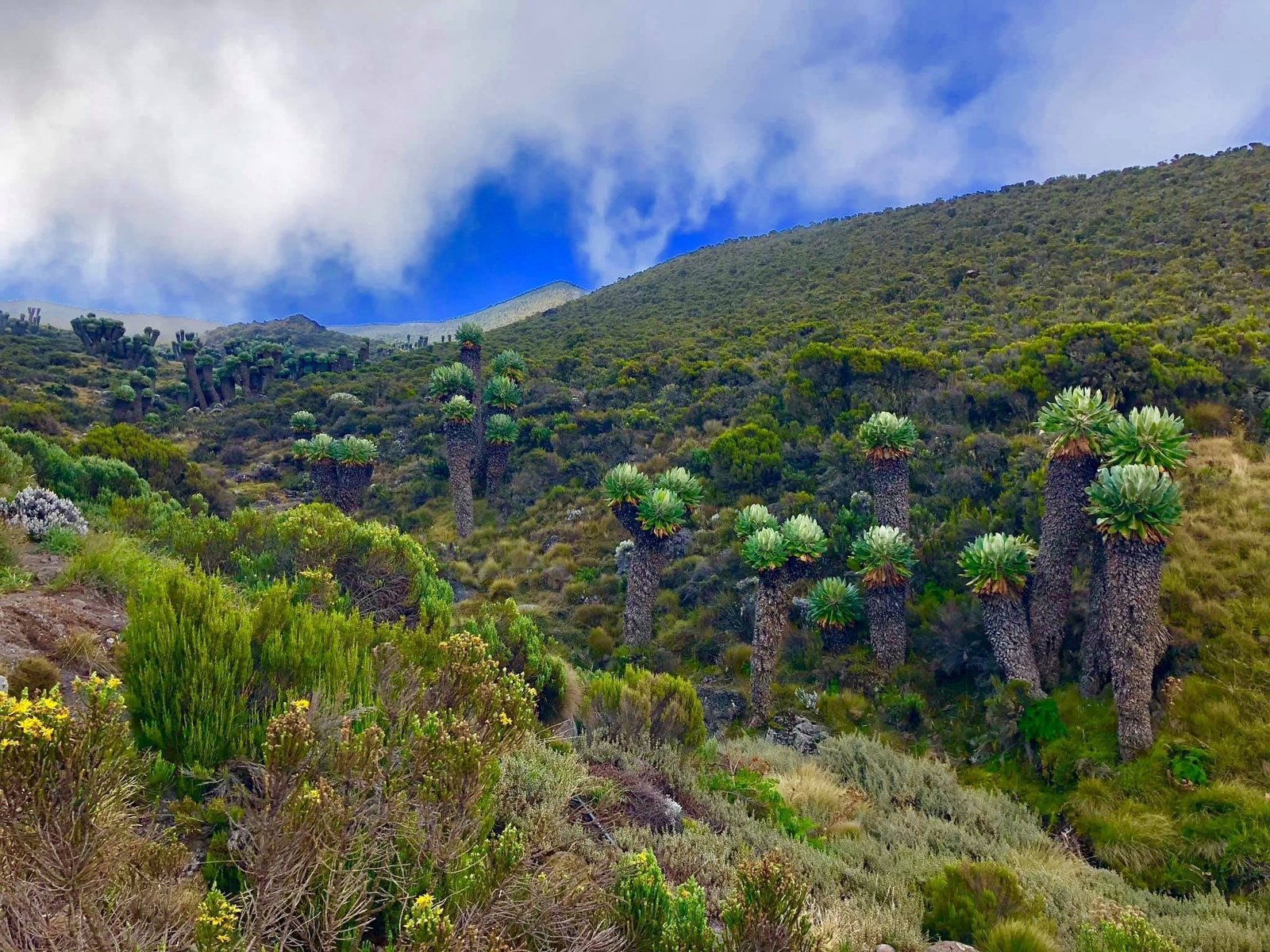
Few plants are more closely associated with Kilimanjaro’s upper slopes. This giant groundsel, endemic to Mount Kilimanjaro, has a thick trunk-like stem crowned by a rosette of large leaves. Some reach several metres tall, creating remarkable landscapes around the Shira Plateau and Barranco Valley. Retained dead leaves insulate the stems; slow growth and other adaptations help the plants endure intense sunshine and freezing nights.
Stoebe
Stoebe kilimandscharica · Typical habitat: upper heath and moorland
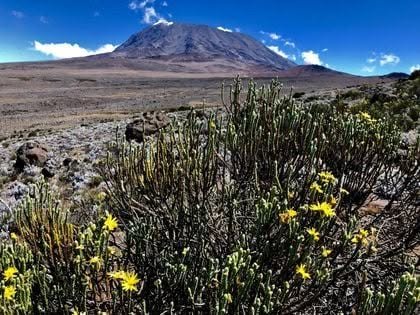
Stoebe is a hardy shrub with slender branches and many small leaves, giving it a fine-textured, bushy appearance. It grows in exposed mountain environments where low temperatures, strong sunlight and wind influence plant growth.
Everlasting flowers
Helichrysum meyeri-johannis · Typical habitat: grassland, heath and moorland
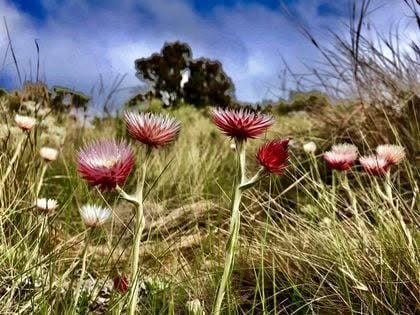
These everlasting flowers add delicate colour among mountain grasses and shrubs. Their small flowerheads can retain their shape and appearance for long periods. “Everlasting” refers to this long-lasting appearance, not to continuous flowering in every season.
High alpine environments
Cold, strong sunlight and dramatic daily temperature changes shape the plants that survive in the mountain’s higher habitats.
Giant lobelia
Lobelia deckenii · Typical habitat: cold, wet high-altitude environments
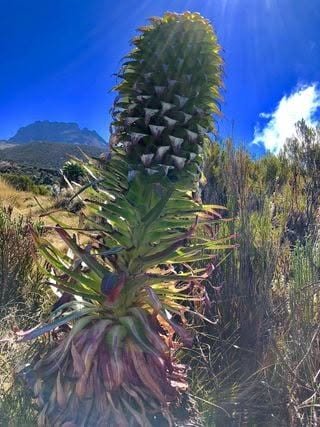
One of the most extraordinary plants of East Africa’s high mountains, the giant lobelia has a towering flowering structure and a compact leaf rosette. It is especially associated with cold, wet high-altitude habitats, where temperatures fluctuate sharply between day and night. Its tightly arranged leaves help protect the growing centre from cold.
Everlasting flower
Helichrysum newii · Typical habitat: exposed alpine environments
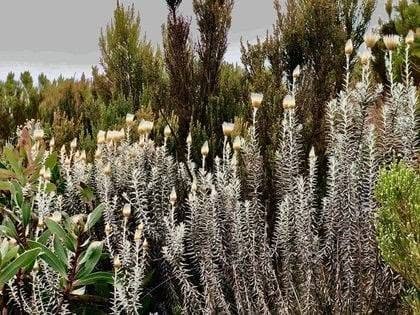
This high-altitude everlasting flower has compact growth and pale, densely packed foliage suited to cold, exposed conditions. Its woolly covering helps shield the leaves from intense sunlight and freezing nights, allowing it to persist high on the mountain where few other plants survive.
Protecting a Fragile Mountain
Kilimanjaro’s plants have adapted to very different environments, from humid montane forests to exposed alpine slopes. Some high-altitude species grow slowly and can take years to recover from damage. Stay on designated trails, avoid picking flowers or disturbing vegetation, and carry out your litter. These simple actions help protect the mountain’s remarkable biodiversity for future climbers.
Keep reading & plan your climb
Kilimanjaro Knowledge Base
A day on Kilimanjaro
Food on Kilimanjaro
Kilimanjaro Beginner’s Guide
Altitude & Safety
Official ecological reference
Ecological descriptions are informed by Tanzania National Parks (TANAPA) information. Wildlife sightings are possible, not guaranteed.